I took 25 Irish dental clinic websites, picked at random across Dublin, Cork, Galway and Limerick, and checked one thing on each: what fires the moment a patient lands, before they have agreed to anything. No names — these are observations, not verdicts. The result was heavier than the law firms I checked the same way.
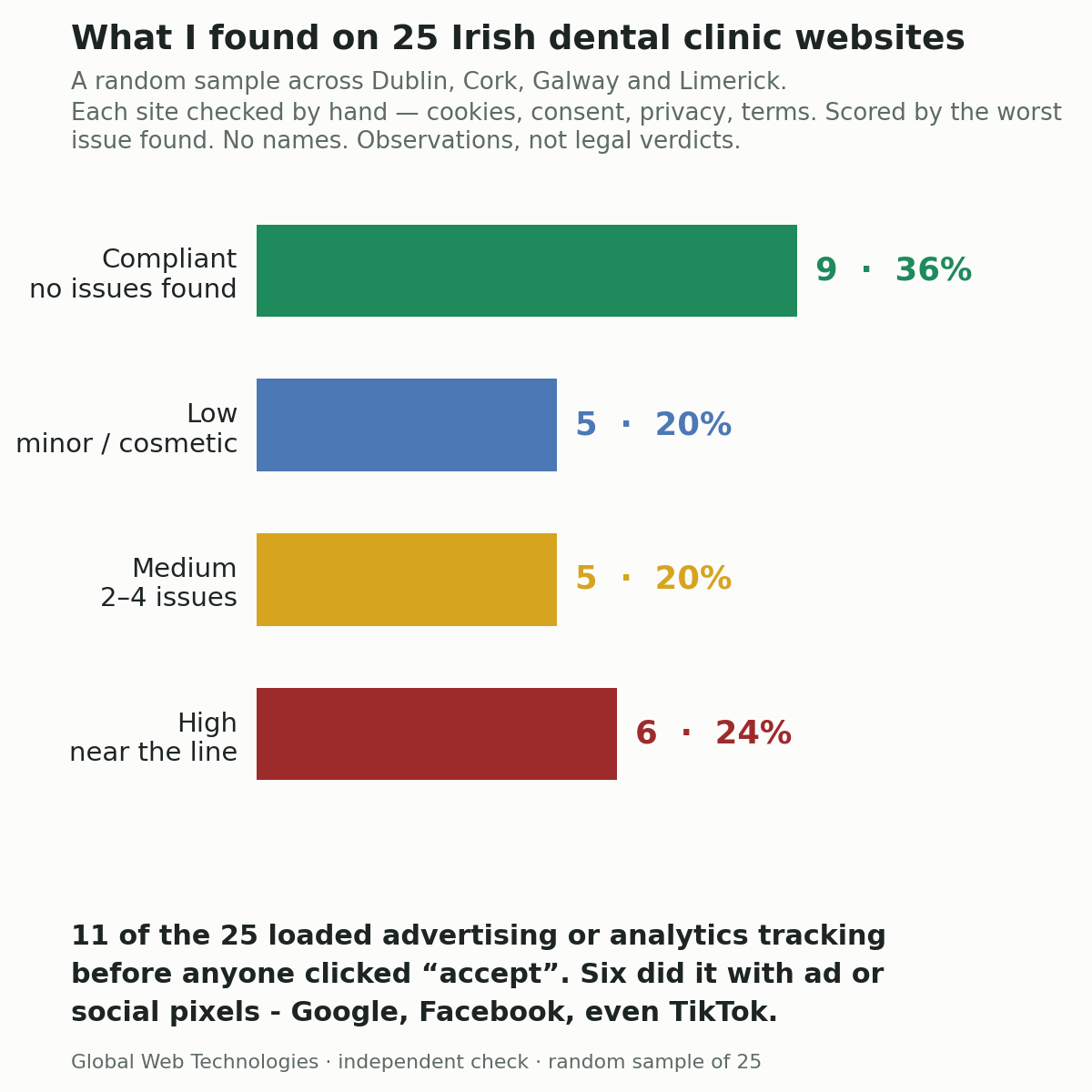
Eleven of the 25 were tracking before anyone touched the cookie banner. Six of those did it with advertising or social pixels — Google, Facebook, and in two cases TikTok. One clinic had four trackers firing at once, behind a banner that did nothing. Nine of the 25 were clean. The rest sat in between.
Two privacy pages belonged in a museum. One still cites the EU-US Privacy Shield, the transatlantic data framework struck down in 2020. Another still quotes a fee of 6.35 euro to see your own data — a charge GDPR abolished in 2018. Pages like these are rarely dangerous in themselves, but they are a tell: if nobody has read the legal section in years, nobody has looked at the tracking either.
None of it looked deliberate. A pixel gets dropped in for a campaign — implants, clear aligners and whitening are all advertised hard — and nobody sets it to wait for consent. A policy gets copied from an older site. The intent is ordinary marketing; the wiring is the problem.
It matters more in a dental setting than almost anywhere. The person landing on the page is often anxious, sometimes in pain, and frequently about to hand over their name, number and reason for calling in order to book. That is the precise moment "agree first, track second" is meant to protect — and the moment a stray advertising pixel is least welcome. Some of what I found is the kind of thing a regulator would notice.
The better news is that nine clinics had it right, so it is plainly achievable. A clean site is not a budget problem. The tracking waits for consent, the privacy page says what is true, and nothing follows a nervous patient around the internet because they once looked up a crown. It is not hard. It is just rarely checked.
Curious what your own clinic site does before a patient agrees to anything?
The free brief answers exactly that. I take an independent look and tell you straight whether there is anything worth checking — and sometimes the honest answer is that you are grand, so do not spend money on it.
Start with a free brief →